Book End Statement

An amalgamate is one who is a freak. It identifies as an individual, yet shares appearance of many. It lies in the uncanny valley, a nudge away from ressemblance missing the mark by a hair, a plural identity within a singular. As a third culture kid (TCK) myself, I resonate with this feeling being a cultural amalgamate. TCKs are born in a country, travelled to foreign places in their childhood, but too quick to call any place as a home, leaving behind a fragment of belonging in every place they transit. They never feel at home, yet could call many places home at the same time. These uncanny cultural amalgamates challenge homogeneous identities, be it ethnic, nationalities, or ideological imposed upon them. Never neatly fitting into categorization.
In this unit, the enquiry challenges the cultural hegemony narrative through auto-ethnographic explorations as a TCK.
My enquiry started by understanding cultural marxism’s take on Identity, challenging the contemporary narrative that an individual’s identity is purely constructed, rooted in the ideological systems hidden in their environments (social and historical). These contentions stem from biblical texts, arguing that the identity is designed, therefore exists transcendentally, and is inherent in each individual (“… you knit me in my mother’s womb.” Ps. 139:13-18). This aspect of transcendence gives a perspective that views identity has an element of stability, and ultimately suggests it is designed with a purpose. The visible, then, are reflections of this objective identity as a truth rooted in its author. My projects then begs the question—how can plurality of cultural perspectives and experience reveal rather than obscure the unity of identity, and how can graphic design make visible this unity within diversity?
Neo-Marxist thought offers a compelling critique of how identity is formed within modern society. It views the self not as an independent essence but as a product of historical and material forces. From this perspective, who we believe ourselves to be is deeply conditioned by systems of power: class, ideology, and culture. Louis Althusser describes how individuals are assigned into social roles: “hailed” by ideology to see themselves as subjects who sustain the very systems that shape them. Identity, then, becomes not self-possession but a reflection of external conditions: structured, controlled, and reproduced through power.
This thought then sees the world as competing ideologies in constant struggle of hegemonic dominance in culture. Structures constructed to dominate alternative minor cultures, subjecting them to the will of those in power. We can therefore commonly see themes of resistance, and identity fragmentation in contemporary arts and design, fighting to make visible an alternative reality.
Yet what if one does not fully belong to any single culture? From where does such a person draw the power to resist? My work departs from the paradigm of perpetual cultural struggle and instead seeks reconciliation. As a TCK, my ambiguous cultural position frees me from the need to lay claim to one heritage. Having none exclusively, I inhabit aspects of all. This makes it easier to avoid the trap of seeing identity as reducible to group identities, and instead see that there is a transcendent aspect instead. Through this lens, my practice explores how multiple cultural influences can coexist within one self, suggesting that all cultures—rather than competing for dominance—can serve as valid and authentic reflections of this identity.
This essay is divided into three main sections:
01 Structures communicating meaning of one’s identity
02 Mechanics of identity morphology, and identity
03 Formation and reflection through objects.
01 Structure
First, I introduce my TCK background by exploring the paradoxical meaning of claiming a national identity while culturally partly foreign. This exploration dives into three frameworks of meaning-making that either reduces or constructs my identity, trying to make sense my statement “I am a Indonesian”. This exploration laid out parts of my heritage and explore how the build meaning to the sentence from the different frameworks. The exploration process was presented as a video essay, using hybrid cultural elements in imagery, charts and typography.
02 Mechanics
In exploring mechanics, this project explores the theories of Adhocism combined with the Conditional Design Method. Objects we grew up with, liked or disliked, define who we are. Despite their system origins that built these objects, we can break them down and see them through our individual lens. Adhocism states that everything is built upon the deconstruction of things into “multivises,” or parts that can be reused into part of other things, then promptly reconstructed into new things. With different conditions or contexts, these parts can be then constructed into something else, bridging connections even between seemingly opposing systems. Resisting the narrative of west vs east power struggles, my project explores creating a “cultural handshake” between the two by creating a conditional bridge, enabling eastern aesthetics to morph into the western and vice versa.
03 Auto-ethnographic Objects Posters
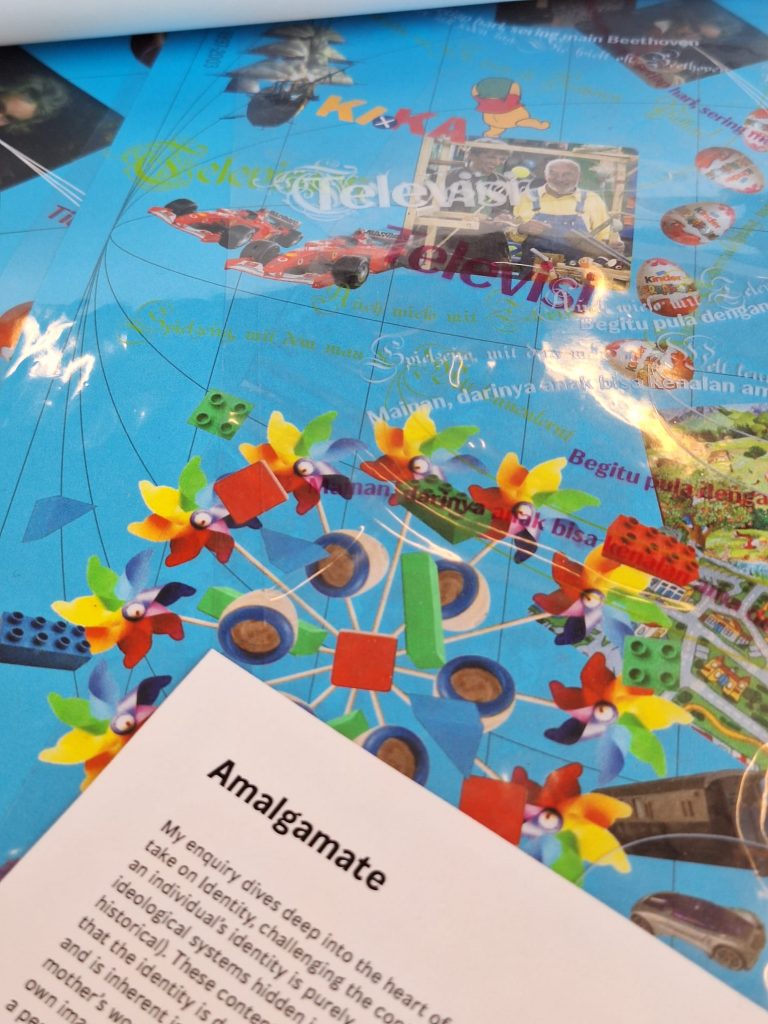
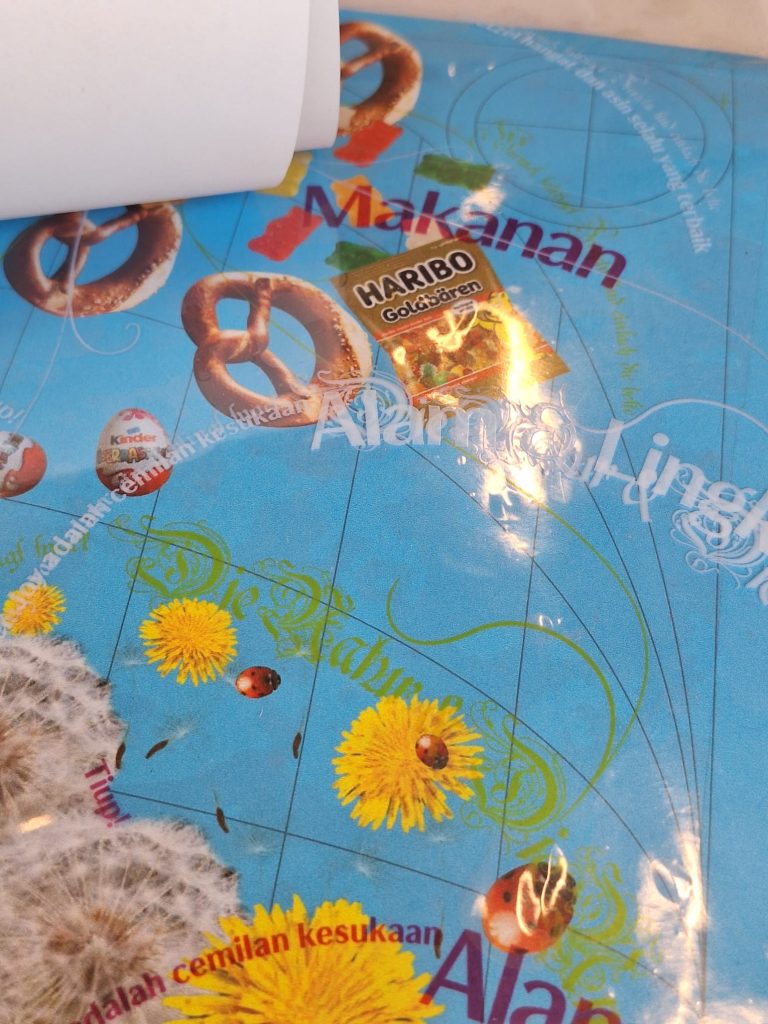
Lastly, I created auto-ethnographic maps divided into three periods. I laid out notable objects that I identified with, or simply liked or disliked that colored my growth journey. The map speaks to revealing hidden identities, showing how I instinctively reacted to them through the layout and choice of colors. The choices made of which objects to include or excluded also speaks to my individual biases and character as the map-maker. These objects then in a way is adhoc to the reflection of my own identity. The comparative maps theoretically reveals the shift and progressive revelation of my own identity through different cultures and times, making visible the responsive properties of the transcendent identity.
In conclusion, while cultural marxism exposes power dynamics that shape identity, my work reconstructs how meaning is built and revealed. Between them lies my enquiry, whether identity, fragmented by ideology and culture can be relooked at as a designed unity. There is hope in seeing the self not simply an after product of circumstances, but also having a transcendent quality, giving stability with the possibility of direction and dynamism, seeing how the chaos and multiplicity of life enforce rather than obscure the self. If we are to communicate, it is crucial to know who the self is, where it is going, and where it is coming from.
This exploration hopes to contribute to cultural diversification and growth through interactions, exchange and mutual respect in an ever increasing migratory world. Intercultural exchange is going to be more frequent and it is exciting to see how they progress and enrich how values are diversely displayed. Graphic and communication design should be one of the first visible signs of an ever changing cultural landscape.